SUPERLUX D103/01P
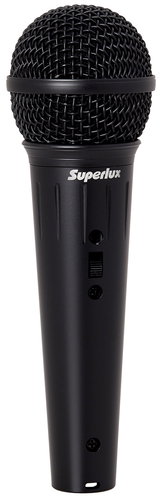

SUPERLUX D103/01P
The SUPERLUX D103 is an affordable dynamic microphone. It is ideal for singing. It has a supercardioid polar pattern. The microphone has a sufficiently stable capsule that is resistant to shock and movement. The resulting sound is full and rich, especially in the higher frequency bands. The microphone operates in the 50Hz–15kHz band with an impedance of 500 Ohm. The package also includes a holder and a 3-metre XLR – 1/4 Jack cable.

Handheld (into a holder)
Microphone type
Dynamic
Microphone principle
Directional (cardioid)
Polar pattern
50–15,000Hz
Frequency range
Key Features of the SUPERLUX D103/01P Microphone
- Mute button
- Affordable dynamic microphone
- Features a sufficiently stable capsule
- Includes a holder and 3-metre XLR – 1/4 Jack cable
- Suitable for singing
- The sound is full and rich

Suitable for Singing

Technical Specifications
- Output impedance: 500 Ohm
- Sound character: full and rich sound, especially in the higher frequency bands
- Construction: stable capsule resistant to shock and movement
- Controls: Mute button
- Connection: XLR
- Accessories: microphone holder, 3m XLR – 6.3mm Jack cable
Package Contents
- Microphone
- Holder
- 3-metre XLR – 1/4 Jack cable
 Microphone Principle
A dynamic microphone is suitable for outdoor performances, live broadcasting, music production, etc. It uses a magnet and a moving coil to capture sound.
A condenser microphone is mainly used for studio purposes. It has higher sensitivity and lower noise. It requires its own power supply.
 Frequency Range
The frequency range indicates the range of frequency values that the microphone records. The wider the range, the more sounds it can capture.
Low frequencies (e.g., 20–200Hz): Bass, the lowest tones of instruments (double bass, kick drum) and male voices.
Mid frequencies (e.g., 200–3,000Hz): The body of instruments, the fundamental of the voice, where the ear is most sensitive, important for speech intelligibility.
High frequencies (e.g., 3,000–14,000Hz): Treble, details, sibilance, and the "sheen" of the sound.
Air band (above 14,000Hz): Gives recordings a feeling of expensive, super high-quality sound and space.
 Sensitivity
A microphone's sensitivity is the ratio of the output voltage to the acoustic pressure. It expresses how loud a signal the microphone produces at a given acoustic pressure; higher sensitivity means a stronger voltage and is suitable for quiet studios, while lower sensitivity is better for noisy environments as it amplifies less unnecessary ambient noise.
Specifications
Microphone characteristics
Features
Weight

AUDIO PARTNER s.r.o, Mezi Vodami 23, Praha 4, 143 00, [email protected]
Specifications can be changed without notice. Images are for illustrative purposes only.